Welcome to my blog!

Welcome to my blog! This is my journey, my first steps into the world of fictional writing. This blog is an online journal of sorts, where I share the progress of my work as well as what I have learned along the way. I hope you enjoy your time with me and that my experience may be of some use to you.
Showing posts with label mystery. Show all posts

Monday, June 12, 2017

By the Book: Nightshade

Welcome back,


This month’s book is a drama/mystery/thriller entitled Nightshade, by Canadian author Tom Henighan. I was a little disappointed in this book, but found it a worthwhile learning experience nonetheless. Read on to see my thoughts on why.


My reasons for choosing this particular book was simple; I was pressed for time. Both my personal and professional life have been keeping me busy, not to mention my schedule for book reviews required I read three books in one month in order to meet my deadline. Out of the books I had on hand, Nightshade met several requirements I was looking for; it was not Sci-fi/horror/fantasy, its title/cover/theme could be associated to spring, and it was short (less than three hundred pages).


The story is about private detective Sam Montcalm, and his investigation into the murder of a renowned scientist. The primary suspect is an artist and environmental activist, who also happens to be Sam’s friend. We follow Sam as he works to find the true killer, and prove his friend's innocence. In true noir detective style, we see Sam do everything from rough up sources for information to flirt with potential suspects.
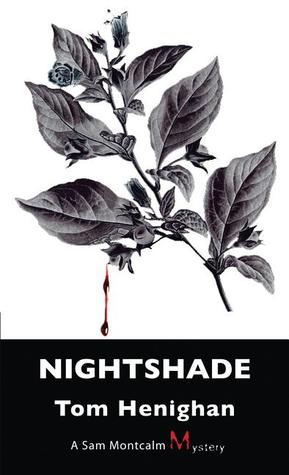

Image result for nightshade tom henighan


Back of the book:
Deadly nightshade – the poison plant par excellence – and in historic Quebec City at an important scientific conference concerning the genetic manipulation of trees it means murder!
Police, RCMP, and a mysterious FBI agent from Washington converge on the scene. But the sharpest eye belongs to Sam Montcalm, a despised "bedroom snooper" from Ottawa whose primary concern is to clear a First Nations activist of the crime. Sam is middle-aged, tough, and sophisticated, yet he’s also a lone wolf who feels displaced nearly everywhere, and his relations with his colleagues, the police – and with women – are always complicated. "You’re a psychic wound without a health card," a friend comments
The story moves to its surprising climax as Montcalm follows the trail of murder back to Canada’s capital and into the Gatineau Hills, his deep sense of cynicism about human nature confirmed as he closes in on the killer and struggles to come to terms with himself.


***(POSSIBLE SPOILER ALERT BEYOND THIS POINT)***


What I learned from this book:
  • Commitment/Pay Off ratio: One of the lessons I took to heart in the last few years is when you have an audience stick through 200+ pages of a story, there better be a payoff at the end. On a few occasions I have felt cheated at the end of a book; having invested time and interest on a story only to feel disappointed at the end. In this case, the protagonist, a Private Investigator, sees a friend die, another friend blames them for the death and he loses his job. On top of that, the crime is solved by tertiary character, and the antagonists escapes custody.
  • Drama-Mystery: After completing this book, it came across more as a Drama than a Mystery. The story seemed to focus more on passion, disappointment and treachery rather than investigation. There was very little action, which made the entire story feel more like an exploration of the suspects motives rather than actual researching for clues.
  • Location research: Imagine my surprise when I found out this story takes place in my backyard! The setting happens between Quebec city, Ottawa, and my hometown of Gatineau. It was great to see the author lived near my area, detailing locations I was very familiar with. However, I discovered that research will only take you so far. The physical descriptions of the area were fairly accurate, but the author’s rendering of the local population and social setting seemed off.


Tom Henighan was born in Manhattan, and grew up in Westchester County. He came to Canada in 1965, where he got married to his second wife in 1970. He also had his second son in 1979. He lives in Ottawa, and teaches at Carleton University. Tom’s works of fiction, nonfiction, and poetry include The Maclean's Companion to Canadian Arts and Culture, The Well of Time, and the YA novel Viking Quest (2001).


For those interested in reading more books from Tom Henighan, please check out his website at https://tomhenighanjournal.wordpress.com/about/


In closing, I would like to thank you all for dropping by and following my blog. Your patronage and encouragement is truly appreciated.


Until next time!


Cheers,

            Patrick Osborne

Thursday, June 23, 2016

By the Book - Stalking the Angel


Welcome back,


In the past, my tastes in books gravitated around sci-fi and fantasy. As I mentioned before, my interests have expanded over the recent years since moving in with my wife, as she made me discover police dramas and thrillers. So I figured it was time to go back out of my comfort zone, and try another mystery novel! The book featured in this month’s review is from one of the boxes donated to us from Linda’s family, and is called Stalking the Angel by Robert Crais.


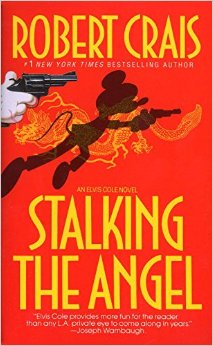
Let’s be honest, what originally drew me to this book was its Mickey Mouse cover. The combination of bright colors and shocking image of the world famous, family friendly rodent holding a gun got my attention. After reading the first few pages, I was stricken by the main character, Elvis Cole, whose personality felt like a cross between Sam Spade and Ace Ventura. With that mental image in mind, the story that followed was interesting indeed.


The story follows the escapades of wisecracking L.A. private eye Elvis Cole, and his stone-faced partner Joe Pike. The duo are hired by Bradley Warren, a millionaire hotel magnate, to locate an ancient relic named the Hagakure which was stolen from him. In order to find the priceless Japanese manuscript, Cole’s investigation leads him to little Tokyo, where he is not only exposed to Japanese subculture, but runs into the Yakuza. To solve this nefarious plot, Elvis must find the link between the theft of a Japanese artefact, the kidnapping of a millionaire's daughter and the murder of a Yakuza lieutenant. The ending is not what you might normally expect.


Back of the book:
“The blonde who walked into Cole's office was the best-looking woman he'd seen in weeks. The only thing that kept her from rating a perfect "10" was the briefcase on one arm and the uptight hotel magnate on the other. Bradley Warren had lost something very valuable - something that belonged to someone else: a rare thirteenth-century Japanese manuscript called the Hagakure.


Just about all Cole knew about Japanese culture he'd learned from reading Shogun, but he knew a lot about crooks - and what he didn't know his sociopathic sidekick, Joe Pike, did. Together their search begins in L.A.'s Little Tokyo and the nest of the notorious Japanese mafia, the Yakuza, and leads to a white-knuckled adventure filled with madness, murder, sexual obsession and a stunning double-whammy ending. For Elvis Cole, it's just another day's work.”


What I learned from this book:
  • Name dropping: I have to do some more research on how to use copyrighted material in a book,  because what Robert Craig has managed to do in this story baffles me. On multiple occasions, the author makes references or comparisons to pop culture. Anything from Marvel, to Disney, to McDonald’s… a good example is his Pinocchio clock in Cole’s office, or his constant referencing to Jiminy Cricket. This successfully anchors the narrative in a modern timeline, and  helps the reader to better visualize what the author is describing. All these eclectic collectibles also give the audience an idea of Cole’s personality.
  • Describing the setting: There were so many details given in this book, I feel like I could just google map the setting. The protagonist often says which road he is taking, what address he is going to, etc. While investigating, Elvis describes his surroundings in detail, noticing elements which either stand out or are oddly missing. This information is used as either clues to further the plot, or red herrings to throw Cole (and the audience) off the trail.  
  • Life of a Detective: Contrary to some of the other crime novels I have read, I feel that Stalking the Angel gave me a more realistic look into the life of a detective. By that I mean investigations are not always about analyzing clues, interrogating suspects or busting heads (though the story has plenty of that too). There is a lot of waiting, such as stake outs, driving around or waiting for calls. This story had a fair share of downtime, showing that detective work isn’t always fast paced, and can be tedious just like any other job.
  • First person, Omnipresent: The entire story is told from Cole’s perspective. His inner narrative helps the audience see his logic and understand how he came to his conclusions. Not to mention Cole’s inner dialogue often makes for a good laugh.


Best-selling author and Louisiana native, Robert Crais, has not only written books, but scripts for television series and Movies-of-the-Week for major networks. His work include the best-selling Elvis Cole novels, and TV series such as Hill Street Blues, Cagney & Lacey, and the ever popular Miami Vice.


For those interested in reading more books from Robert Crais, please check out his website and wiki description, where you can find a complete listing of his published works and all other pertinent information:


In closing, I would like to thank my wife Linda for her support, and her family for lending us these books. The tremendous amount of encouragement they have shown me since the beginning is what keeps me going.


Until next time!


Cheers,

            Patrick Osborne