Welcome to my blog!

Welcome to my blog! This is my journey, my first steps into the world of fictional writing. This blog is an online journal of sorts, where I share the progress of my work as well as what I have learned along the way. I hope you enjoy your time with me and that my experience may be of some use to you.

Friday, October 9, 2015

The Scare Factor


Welcome Back!


           For the month of October, I felt it would be inspiring to have a Writing post focused on one of my favorite times of the year: Halloween! A holiday filled with ghosts, monsters and stories about the paranormal. By the time this entry goes online, I will most likely have begun my yearly ritual of indulging in a plethora of horror movie marathons.

It was a dark and stormy night...


Horror is changing. Readers have grown so accustomed to the same old classics of horror, such as vampires, ghosts and werewolves, that they have become numb to them. In order to stay relevant today, horror stories need to feed on the fears of those who are reading it. They must have some level of plausibility and originality in order for the audience to connect with them. If the writer succeeds in making terror feel lifelike, be it about a subject as realistic as spiders or as fictional as zombies, then the audience will accept it could happen and be drawn into the story.


So how exactly does one achieve the “scare factor”? The fundamentals of horror are fear, tragedy, and whether or not one is capable of overcoming them. Unlike horror movies, where tone is set with the use lighting, music, “jump scares” and visual effects, writers are limited to using words alone to frighten their audience. How do we get a reaction from our readers when they can't see or hear what is happening? The trick is to jog the reader's imagination, helping them visualize the story by feeding them the appropriate information or exploiting their other senses (for more information see my post Showing and Telling). This is achieved in storytelling with the use of vivid settings, strong characters, worthwhile conflict and a compelling plotline. Let us explore the following four categories and see how they contribute to the horror genre.


The Protagonist:


The characters are the writer's most important tool, as they are the link between the reader and the story. In order for characters to properly serve their purpose, the audience must be able to identify with them on some level. When the readers feel connected to the characters, they will care for what happens to them.


Characters also serve as translators of the world around them, as their reactions help readers better interpret what is happening. This is a key component to the horror writing process, because by being privy to what goes on in the character's head, the audience can share their experience. Horror is best reflected through character reactions in three ways: the mind (with reactions such as confusion or going insane), the heart (with feelings such as despair or dread) or the gut (with sensations such as paralysis or pain).


Finally, tragedy is best portrayed through the protagonist in the form of character flaws. These flaws help build up suspense and tension, as imperfect characters usually will make bad decisions, leading to costly mistakes and possibly their downfall. A popular example would be the ditzy blonde who dies in the beginning of horror movies, usually because she makes a series of bad decisions. Though this example has been used to death, it serves an important purpose besides building tension; it serves as a precursor. This builds anticipation in the readers, as they will expect the same result to be repeated with other characters.


The Setting:


           A creepy setting is a great tool to create atmosphere. Remember that human beings, like animals, are biologically programmed to fear the unknown, the unpredictable, the uncontrollable or the uncomfortable. The right atmosphere is crucial when writing a horror story, as it help instill tension in the audience. With this in mind, a writer can set the appropriate mood by playing around with the various aspects of the setting (like locale, geography, time and weather).


Some locations will affect certain readers differently. Places such as cemeteries, swamps, abandoned towns or old buildings have an innately eerie quality to them. If your story takes place in a safe or homely environment, you can darken its mood by having it happen during the nighttime or a thunderstorm storm. You can also choose a location based on a popular phobia in order to target a specific audience. If you want to scare people with claustrophobia, then have the story take place on a submarine or in the subway. To target people with ornithophobia, have the story take place in an aviary or a pet store. To scare people with achluophobia, write a story taking place in caves or in space. If there is a phobia for it, odds are a story can be made of it.


           The right background detail placed in the environment in a specific manner can also contribute to the stories mood. As an example; imagine going on vacation at a prestigious location, staying in a luxurious hotel room. Now imagine finding an eyeball on the floor of said hotel room. Your perception of the surroundings automatically shifts from excitement to dread.


***Note: Though using blood and viscera has been a staple in horror for a long time, it is important to note it is not required to instill fear in the audience. Use gore and violence sparingly, as excessive amounts may desensitize the reader to your content.***


The Conflict:


           Conflict is at the centre of all fiction and without it, a story has no goal. In literature, conflict is the interaction between two opposing forces, that must struggle against each other to achieve their contradictory objectives.


This still applies to horror, however the components of the conflict will take on a darker tone, better supporting the earlier statement of tragedy being one of the fundamentals of horror. We can see these differences by taking a look at the stories objectives, which will seem impossible to obtain, or at the obstacles, which will seem unfair. We get a good understanding of this concept by looking again at the clichéd example from horror movies; the ditzy blonde struggling to survive against an armed psychopath.


Finally, every conflict in a horror story should be accompanied with life or death consequences. These high stakes is the best way to set an even higher level of tension.


***Note: Creating tension is important, but so is creating a feeling of safety. Readers will get tired of stories that try to constantly keep them on edge. Creating a balance between anxiety and normalcy will make it easier to catch readers off guard.    ***
   
The Antagonist:


Also known as the villain, the Antagonist is the character(s) who opposes the Protagonist and creates the conflict in the story. They represents the obstacle that the Protagonist must overcome in order to succeed.


In horror, the role of the antagonist will often outshine the part of the protagonist. This phenomenon is extremely common in scary movies, with examples like Frankenstein, Dracula or the Wolfman taking center stage, as opposed to adventure stories where protagonists like Robin Hood, King Arthur or Sherlock Holmes are the focus of attention. This supports the idea that in order to have a good horror story, you need to start with a good antagonist!


Keep in mind that readers today are looking for something new, different or an unusual twist. To better take your readers by surprise, don't show too much of the antagonist too soon. The unknown is always more frightening than the familiar, so keep the readers guessing.


In closing, one piece of advice that other writers often gave me was to write what I know. Writing from personal experience is a good way to make your stories more compelling, and this remains true to horror. Concentrating on what scares you, then finding the right way to express it is a good way to start your own tale of terror!


Thank you all for dropping by, and I wish you all a Happy Halloween!


Cheers!


Patrick Osborne

Friday, October 2, 2015

Current Projects part 9


Welcome back!                                                                                  


    We are now slowly approaching my second most favorite holiday of the year; Halloween! Soon all of the front yards in the neighborhood will be full of creepy decorations, stores will be selling discounted candy in bulk, colleagues at work will be talking about the costume they plan on wearing for the office party and (my personal favorite) every channel on television will be having their own Horror Movie Marathon!


Happy Halloween!


    In spirit of the season, I decided to have the theme of every single one of my posts this month be inspired by Halloween or Horror. From book reviews to writing games, everything will have a hint of ghoulish ghosts, creepy caves and surprise scares! But no pumpkin spice, that stuff is just over used.


    Speaking of posts, as I mentioned a couple of months ago, my plan was to having one post of each type per month (By the Book, Inspiration, Current Projects, etc). I began looking into a schedule for my blogging, trying to upload new content at different hours of the day to optimize the traffic to my website. Also, I began rehashing some of my older posts in order to bring attention to them again. This has proven useful to fill in gaps in between new content posts. After trying this for a month, I find that not only do I feel less rushed to dish out content, but it gives me more time to plan ahead (like coming up with Halloween themed content!). Traffic to my site has also jumped up from +/- 400 views in a month to +/- 600. So it appears to be working.


    In regards to my work with Missing Worlds Media, the Villain Path that was assigned to me is now completed, edited and submitted for final review to the Continuity Department. Since then I have gone back to writing NPCs (“Non Player Characters” for the non-gamers out there), and have written up a new character intended to be a detective for the in-game police force. His name was mentioned in short stories on the MWM Kickstarter page, but my job was to “flesh” him out and give him a background. This character’s profile has been completed, and was submitted for review in late September.


    As for my own projects, I’ve chipped away at multiple documents, slowly creating the world my story takes place in. I have worked on my “Magic versus Technology” file, further exploring the levels of magic and science in the world I am creating, as well as writing a history for the secret agency named the Cerberus Initiative, which will play a big role in the story. But most importantly, I started a new document this month that I have called the Timeline Crossing Chart. I got the inspiration for this document after reading some news articles on J.K Rowling (the author behind Harry Potter). The chart helps me keep track of characters and ideas in my story, and proved so useful that it helped me get another five chapters planned out. It is so useful, that I may have a post explaining the importance of having a Timeline Crossing Chart in the future.


    One last thought for this update. I have been debating all month taking another writing class. More specifically, the James Patterson Masterclass. I have been seeing it advertised all over the web lately, and keep asking myself if I should take it. I’ve tried alternatives, like listening to interviews or seminars, but I can’t shake the feeling that I am missing out by not taking this class. It’s not that expensive, but with a tight budget, I’m still debating it’s necessity. If anyone has any details about this class, please send me a message.


In closing, I would just like to let everyone know how much I appreciate their support and for taking the time our of their busy lives to come read my blog. And a special thank you to Andy Peloquin and catt dahman for their feedback and interview.


Thank you all again,


Until next time,


Patrick Osborne


Monday, September 28, 2015

By the Book: Conan the Rogue

Welcome Back!


I’m a bit behind schedule this month when it came to my book review. The truth is I had this idea about doing a theme for the month of October, focused on Halloween and supernatural phenomenon in writing. The problem is, the idea came after finishing the supernatural mystery book that was originally intended to be reviewed this month! So I decided to push back the review for that book to October, and had to find a replacement book for September.


That is when I came across Conan The Rogue. I had originally read this book back in high school, but forgot most of what transpired in it. The book was no longer in my possession, as it was donated to the free library at my campsite. However, as luck would have it, the book was still there, so I had the opportunity to read through it once again.


For those of you unfamiliar with Conan, he is a fictional character who is set in a fantasy, “sword-and-sorcery” setting known as the Hyborian Age (a period in earth’s history between the fall of Atlantis and the rise of ancient civilizations). Conan is mainly referred to as a barbarian, but over the years he has also been known under many other names. At his core, Conan is a warrior who fights for his own egotistical goals (money and survival), but will assist others if it fits his needs. The character itself was originally created by writer Robert E. Howard in 1932, and has since appeared in everything from books, movies, television shows and video games.


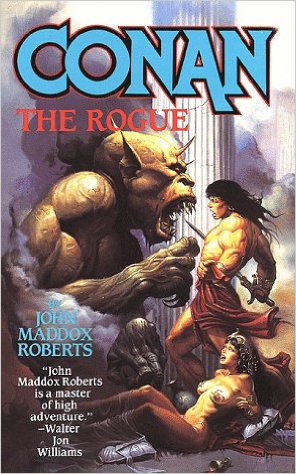
Conan the Rogue is a fantasy novel written by John Maddox Roberts, and was originally published by Tor Books in November 1991. The story begins with Conan out of luck, having lost all of his belongings while gambling, except for his sword. His fortune soon changes, as the barbarian gets hired by a strange, flamboyant man to retrieve a mysterious artefact reputed to have vast magical power. The search takes Conan to Sicas, a once rich city thanks to its silver mines, now in the midst of a power struggle between numerous contenders, most notably the king's corrupt reeve, five different gangs and a religious cult. There are various intrigues and betrayals going on within Sicas, but with careful manipulation, Conan manages to raise the tension until tempers finally boil over, resulting in a city wide brawl. I will skip the details for those interested in reading the book.


Conan the Rogue


Back of the Book:
“Everyone in the corrupt city of Sicas wants the priceless treasure Conan of Cimmeria has come there to find. Beautiful women who offer smiles, kisses--and maybe a knife in the back. A priest who may be closer to his goddess than he thinks. Noble lords, and the bosses of criminal gangs, and a fop whose perfumed kerchief may hide poison. All are willing to kill for the artifact, but none realize the horror in can unleash, a hellish menace that only one man can face…”


What I learned:
  • Dastardly Deeds: The author truly succeeded in making Conan appear to be a cunning mastermind as well as an experienced warrior. Manipulating all of the city’s factions against each other needed careful planning.
  • Planning ahead: Noting what all gangs were doing at all times requires careful planning. In real life, people don’t just stand still and wait for you to be done with what you are doing before acting. While you are off to work, people do their own thing; sleep, chores, exercise or jobs. The clock doesn't stop for others because you don’t see them. The author puts an emphasis on this fact by having Conan constantly keep tabs on the many players taking part in this story. It helps explain who is where, doing what. Reading Conan the Rogue made me realise I needed to apply this to my own story by creating a checklist of who is where during what event. This helps answer questions that may hurt the overall consistency of the story.
  • Apples to Oranges: I was originally worried that reading a book about Conan so soon after reading Kaz the minotaur would give me a barbarian overdose! It turns out, the two are very different, despite being the same “archetype”. Kaz was more of your typical, muscle bound Barbarian, whereas Conan, though he had good intentions, was a double-crossing, manipulative scoundrel.
  • Info dump: Though the story takes place in the city of Sicas, there is a lot of history to predates the actual tale. This somewhat superfluous information appears in large chunks on some occasions, forcing the reader to catch up on the backstory in order to understand the current story. A good example of this is when Casperus takes 3 full pages to explain the origin of the scorpion idle. This has made me realise that I need to parcel my backstory in small manageable bites, and not take the reader out of the main story while doing so.


For those interested in learning more about the author, John Maddox Roberts, please check out the following websites here:


For those interested in learning more about the creator of Conan the Barbarian, Robert E. Howard, please check out the following websites here:


The front cover art for Conan the Rogue was done by artist, Ken Kelly. Follow the link to view their wiki page.


In closing, I would like to thank my wife Linda and our family for the tremendous amount of encouragement in this endeavor.


Until next time!


Cheers,


Patrick Osborne

Thursday, September 24, 2015

Interview - Andy Peloquin


Greetings!


Welcome to my blog’s second writer interview. Today, it is with great pleasure that I introduce to you, Andy Peloquin.


I met Mr. Peloquin via a Facebook page called The Better Writer’s Group, as he was kind enough to respond to my search for writers to interview. He claims being new to the business and is still learning and growing as he goes, but is more than willing to share his knowledge in the following interview.


Short Bio: Andy Peloquin--a third culture kid to the core--has loved to read since before he could remember. Sherlock Holmes, the Phantom of the Opera, and Father Brown are just a few of the books that ensnared his imagination as a child.


When he discovered science fiction and fantasy through the pages of writers like Edgar Rice Burroughs, J.R.R Tolkien, and Orson Scott Card, he was immediately hooked and hasn't looked back since.


Reading—and now writing—is his favorite escape, and it provides him an outlet for his innate creativity. He is an artist; words are his palette.


Published Works: The Last Bucelarii (Book 1): Blade of the Destroyer


Current Projects: The Last Bucelarii (Book 2): Lament of the Fallen  


When did you begin writing?

I "officially" kicked off my writing career at the age of 25, but I have been writing since the age of 8 or 9. It started with the basics (short stories, poetry), and I attempted my first novel at 16. Of course, I promptly deleted it after Chapter 10, and didn't finish anything until the age of 25.


Did you receive any special training or attend a school?

No special training, no education beyond high school. Just a lot of hard work, a bit of natural talent, and a willingness to learn and grow with every sentence I write!


Where do you get your inspiration from?

Where DON'T I get it from? I've gotten ideas from funny pictures, video games, movies, books, comic books, billboards, and milk cartons! You never know when inspiration will strike--you just have to be ready to flow with it!


Do you use any special resources when writing? (other books, computer programs, etc)

Between Microsoft Word and Google Chrome, I have everything I need to write! I keep it simple, organize all my notes in Word, and do any necessary research on the internet.


What is (in your opinion) the most important thing to remember when writing, and why is it so important?

Characters are SO much more important than plot. A good story can be lame without a great character, but a great character can turn even the most mundane situation into something that will grip you right up until "The End".


What is (in your opinion) the most challenging part of writing, and how do you overcome it?

One of the hardest things for me is to find the "right" character flaw for my characters. Use the wrong one, and it can alienate your readers right off the bat. But finding the right flaw will endear the readers to your characters, even when he/she does horrible things!


Did you use an agent? (why or why not?)

I didn't use an agent for this first book in the series, because I wanted to get it out there. I didn't rush through the editing process, but I didn't want to wait around for years to get the book published. That being said, now that I have this book published, I am shopping around for an agent that can help me get it and future works into the right hands.


Did you use an Editor? If not, what process did you use to edit your work?

I ABSOLUTELY used an editor! As good as we think we are at spotting mistakes, a fresh pair of eyes (or three) is always a must.


How did you get your book published? (self-published, Vanity publishing, Mainstream publisher).

It was published by a small indie press, J. Ellington Ashton Press. They are a horror-focused publisher, so the dark fantasy novel was a great fit!


Do you handle your own marketing?
I do handle my own marketing, something I and most writers have a hard time with. It's tough to set aside precious writing time to find and interact with new readers, but it's vital for the success of any writer!


What is your best marketing tip?

Be friendly and get to know people before you try to market/sell your writing to them. People are much more inclined to buy from a new author if they like him/her or what they have to say. Don't smack people over the head with your marketing or promotions, but get to know people and make friends first!


Do you have any advice for other writers?

Prepare for a long, long road ahead! A VERY small percentage of writers "succeed" in the highly competitive world, and it takes a lot of luck, hard work, and time to find your success. Settle in for the long haul, and you have a better chance of surviving your career as a writer!


I hope everyone found this interview as helpful and informative as I did. I would also like to thank Andy Peloquin for taking the time out of his busy schedule to take this interview, it is very much appreciated.


Until Next time,

Patrick Osborne

Friday, September 18, 2015

BOOTCAMP LESSON 6: Perspective


Welcome back!
In this latest edition of BOOTCAMP, we will explore the concept of Perspective. Hopefully this exercise will be able to demonstrate how it affects storytelling and how it can be applied to your work.

Always depends on how you look at it!

Lesson 6: Perspective

As I mentioned in my post about Perspectives, its purpose in storytelling is to be the point of view from which the story is being told. By changing the angle or the voice from which the narrator presents the story to the readers, they can change the influence on the reader’s perception of the story.  A good real life example of this would be witness reports. I learned this while working as a security guard; if five different witnesses saw the same crime, they will give five different stories. Granted those stories may be similar, but they will differ in some aspect. Why? because each witness had their own perspective.

As authors, we have all occasionally been struck with writer’s block. Coming up with ways to write a scene is not always easy, but sometimes playing with perspective can help rectify this situation. Using a different perspective means information will be given to the reader in a different fashion, in turn affecting other story elements such as style and tone. Trying to change how the story is told may also help breath new life in a scene, just remember it is important to be consistent, or else risk confusing the reader.

But enough babbling, now for the exercise!

Rules:
  1. Below you will find a generic scene to work with.
  2. Within that scene, you will see four characters.
  3. Rewrite the scene using the following perspectives:
    1. Told in a first person perspective from the point of view of the victim.
    2. Told in a third person perspective from the point of view of the vendor.
    3. Told in an omniscient perspective from the point of view of the police officer.
    4. Told in a limited omniscient perspective from the point of view of the villain.
       
Generic Scene:
    It is nighttime in a small town. The victim is running down the street at a frantic pace, desperately trying to stay ahead of their pursuer. In their haste, the victim runs past a street vendor, who is talking to a police officer while putting away his merchandise. The officer and vendor look at the running person, then at each other questioningly. A few seconds later, a brute runs by, knocking down the vendor's merchandise without even slowing, too intent on catching up to the victim.”

Hope you have fun giving this exercise a try. For those who aren’t afraid to share their entries, feel free to submit your stories as a reply to this post. Remember, this is a game, so no posting bad comments about other people's entries.

Until next time!

Cheers,

Patrick Osborne