Welcome to my blog!

Welcome to my blog! This is my journey, my first steps into the world of fictional writing. This blog is an online journal of sorts, where I share the progress of my work as well as what I have learned along the way. I hope you enjoy your time with me and that my experience may be of some use to you.
Showing posts with label comedy. Show all posts

Friday, August 26, 2016

By the Book - Science Fiction


Welcome back,


            I chose the following book, Science Fiction, because it sounded different from what I usually read. It is a retro/sci-fi style adventure, pitting humans against world conquering aliens. I came across this book at the free library at my campsite, and had the opportunity to read it over a week end. Though this makes it sound like my reading speed skills magically increased to record breaking levels, I must confess that the book is roughly sixty pages long. Despite its diminutive size, I still managed to take away something from this novella.


The No-Frills Books were a series of novellas with generic black and white covers published in 1981. There were a total of four books in the series, each meant to represent a different genre; Mystery, Romance, Western, and Science Fiction. Today I am reviewing the book called Science Fiction, which is an obvious comical look at old-school retro sci-fi, complete with outlandish plot, stilted dialog and one-dimensional characters. This book was intentionally written in an exaggerated manner and filled with throwbacks and clichés. Bottom line; it is so bad that it is good.  
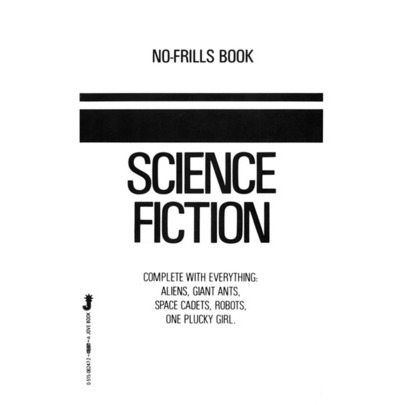


Back of the Book:
“Science Fiction: Complete with Everything: Aliens, Giant Ants, Space Cadets, Robots, and One Plucky Girl”


Could not find any official site for this publication, so here is a listing on Amazon: https://www.amazon.com/Science-Fiction-Complete-Everything-No-Frills/dp/0515062472


What I learned:
  • The importance of editing: If I ever had the opportunity of publishing a novella, one of the first things I would do is make sure it was well edited. Unfortunately that is not the case with Science Fiction. In a story that is not even sixty pages long, I found several spelling mistakes.
  • The importance of consistency: The style of this story was meant to have stereotypical characters and plotlines, however I found there were a few inconsistent elements throughout the book. The most obvious culprit was the lead female character, who plays the role of the strong independant woman in the first few pages, only to turn into a damsel in distress by the end of the book. Also, the goal of the main protagonist was to save his father, but what is the point if doing so means the world gets destroyed in the process?
  • Retro Fiction: One thing this book got right, was embody the retro-sci fi experience. It successfully recreates the feeling of a futuristic setting as imagined in an earlier era. Just any science fiction story can include elements such as aliens and robots, but details like giant insects and bubble glass helmets is what gives this story it's retrofuturism tone.  


There was no author listed on this publication, only the publisher (Jove Books) who I can only assume either wrote the book themselves, or contracted someone to do so. For those interested in learning more about Jove Books, please check out the following website:


In closing, though this book had its fair share of shortcomings, it did succeed at its goal, which was to entertain. Not to mention it did teach me a few important points as well. I would like to thank my wife Linda, my family and my friends for the tremendous amount of encouragement they keep giving me during this endeavor.


Until next time!


Cheers,

            Patrick Osborne

Friday, May 27, 2016

BOOTCAMP LESSON 13: Improvisation


Welcome back!


    I have a little something different planned for today’s Boot Camp exercise, as it  was inspired by last month’s writing article on comedy.


During my research, a point that was mentioned on multiple occasions was that a writer must be able to be spontaneous and improvise. Though this is an easy concept to understand, putting it into practice is another matter entirely.


In order to practice our ability to extemporize, I came up with an exercise that has several randomized components. Having to deal with elements we have no control over will force us to find a way to make these elements work together.


BOOTCAMP LESSON 13: Improvisation


The basics of a story is a plotline which follows the exploits of the main characters as they attempt to resolve a conflict while making their way to their intended goal. When we write a story, it is our job to come up with these elements. In the following exercise, however, you will have to create a short story using various elements chosen at random.


You will need a six-sided dice for the purpose of this exercise. If you don’t have any handy, you can use an online dice program such as this one: http://www.roll-dice-online.com/


So, here are today's guidelines!


  1. Below are six main character candidates. Roll the dice and use the character with the number corresponding to your result.
  2. Next are six stylized worlds/environments. Roll the dice and use the setting with the number corresponding to your result
  3. Next are six sidekicks. Roll the dice and use the character with the number corresponding to your result
  4. Next are six obstacles. Roll the dice and use the obstacle with the number corresponding to your result
  5. Next are six goals. Roll the dice and use the goal with the number corresponding to your result
  6. Write a short story using all of the components you acquired. There is no limit to this exercise.
  7. Within the short story you will write, the components you acquired may be modified to fit each other, BUT must remain true to their original designs as much as possible.


Main Characters
  1. Sherlock Holmes
  2. Robin Hood
  3. The Tin Man
  4. Red Riding Hood
  5. King Arthur
  6. Cleopatra


Settings
  1. Post Apocalyptic Wasteland: For one reason or another, the world has gone through a terrible change. Civilization as we know it no longer exists, and those who managed to stay alive must now scavenge for supplies and fight other survivors for resources.
  2. Police crime scene: Detectives, SWAT teams, Bomb Squads, Computer Crimes Division, Police Precincts, Forensics, etc. Law enforcement attempts to put a stop to illegal activity or investigating mysteries by tracking down  various sources or suspects.
  3. Superhero battle in downtown metropolitan: Superheroes strive to uphold justice and bring balance to society. Unlike the normal police force, superheroes have strange powers to assist them in dealing with super criminals that are a threat on a global scale.
  4. Retro Sci-fi Spaceship: Retro Sci-fi can be described as the future as seen from the past, or the past as seen from the future. Influenced by the scientific, technological, and social awareness of the present, this world reflects the best humanity can hope for.
  5. Deserted Island: Being stranded on a deserted island, the character must to live off the land by finding food, water and shelter. Characters may also be forced to deal with isolation, or else face possible insanity.
  6. Coffee Shop: An everyday coffee shop, filled with people enjoying their drinks or working on their laptops.


Sidekicks
  1. A priest
  2. A mime
  3. A ''D-list'' Super Hero
  4. A bearded hipster
  5. A Cosplayer dressed as a random Anime Character
  6. An Alien


Obstacles
  1. A pack of ravenous badgers
  2. A zombie horde
  3. A flood
  4. A stampede of angry, Emo teenagers
  5. An axe wielding serial killer
  6. A flock of flying monkeys


Goals
  1. To save the world
  2. To save the girl/guy/significant other
  3. To save themselves
  4. To prevent corruption of society
  5. For the LOLz
  6. Profit!


For those who aren’t afraid to share their entries, feel free to submit them in a private message to me via facebook, and I will post them here. Remember, this is a game, so no posting bad comments about other people's entries. Now pardon me while I go write a story about Sherlock Holmes and his Mime sidekick, as they try to survive a zombie apocalypse in a dystopian future… for the LOLZ.


Now go! Create! And most importantly, have fun!


Until Next time!


Cheers,


Patrick Osborne

Friday, April 22, 2016

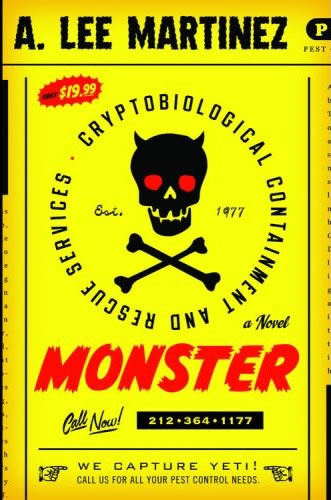
By the Book - Monster


Welcome back!


In honor of April Fools day, the selection for this month’s book review was inspired by the literary genre most befitting of the celebration of pranksters: Comedy. I’m not someone who laughs easily, so when it came time to try and find a comedy themed book, I went back to an author that had me chuckling last time I read him: A. Lee Martinez.


    After a pleasant experience with The Automatic Detective, I was looking forward to reading something else written by Martinez. While looking at a list of his works, one stood out as it sounded a lot like the project I am working on; a story about an inhuman individual who hunts monsters. This immediately got my interest, which explains why I chose Monster.


    This story takes place in a contemporary setting, but in this reality, magic and mystical creatures exist. However, these elements remain imperceptible to most of the general populace, and those who do see them, forget any encounters with the supernatural shortly after. The story focuses on a man named Monster, a Cryptobiological control service agent and Judy, a store clerc. Their adventure begins after crossing paths during a yeti attack in the store Judy works at. They keep running into each other during other crypto attacks, which begins to raise suspicion after the number of encounters defies all logical odds. The mystery leads to further twists and turns, when they realise that the appearance of a third party is responsible the rise in the monster population.


The book can be found at:


Back of the Book:
Meet Monster. Meet Judy. Two humans who don't like each other much, but together must fight dragons, fire-breathing felines, trolls, Inuit walrus dogs, and a crazy cat lady - for the future of the universe.


Monster runs a pest control agency. He's overworked and has domestic troubles - like having the girlfriend from hell.


Judy works the night shift at the local Food Plus Mart. Not the most glamorous life, but Judy is happy. No one bothers her and if she has to spell things out for the night-manager every now and again, so be it.


But when Judy finds a Yeti in the freezer aisle eating all the Rocky Road, her life collides with Monster's in a rather alarming fashion. Because Monster doesn't catch raccoons; he catches the things that go bump in the night. Things like ogres, trolls, and dragons.


Oh, and his girlfriend from Hell? She actually is from Hell.


What I learned:
  • Character contrast: Having a distinctive cast of characters is important. Different personalities help advance the story by telling it from different perspectives. For example, in this story we see the characters of Monster and his sidekick Chester play well against each other, as the first is aloof and ill-mannered, and the other is polite and professional. However, when you take a look at Monster and Judy, the two are so similar to a point that it makes the story slow down or feel stagnant in sections where they interact. This contrast helps underline the importance of variety in characters
  • Making it funny: Martinez proves to be successful at implementing comedy in his works of fiction. Though Martinez says he sees himself as more of a fantasy writer than a comedy writer, his witty style and humorous visualizations make for an enjoyable read.  
  • Playing with the source material: In an interview found in the back of the book, Martinez admits one of the bonuses of writing fiction with elements such as magic and mystical creatures, is that it saves on research. Creatures like Yeti’s or Griffon’s don’t exist, so a writer is free to use, interpret and/or alter them in anyway they see fit.


A. Lee Martinez is an American fantasy and science fiction author who was born in El Paso, Texas on January 12, 1973. He has written several published fantasy novels, which have been translated into five languages.


For those interested in reading more books from A. Lee Martinez, please check out his website and wiki description, where you can find a complete listing of his published works and all other pertinent information:


In closing, I would like to thank my wife Linda and our family and friends for the tremendous amount of encouragement they have shown me since the beginning. And a special mention to my good friend John for introducing me to this great author.


Until next time!


Cheers,


Patrick Osborne
Wednesday, March 16, 2016

The punchline! Writing comedy.


Welcome back,


    I’m a stern person by nature. Just ask my wife, she will confirm my tendencies to over dramatize simple situations or that I take things too seriously. I’m also not a big fan of comedy movies, and have an ever-growing list of comedians that irritate me. It also appears that I am afflicted with a medical condition known as “resting-bitch-face”, which apparently makes me scary to some animals and small children.


Comedy is, in my opinion, probably one of the hardest genres of writing out there. Not everyone has a sense of humor, finds the same things funny as you do or is capable of understanding a punchline. Regardless of the type of story, incorporating comedy can be of great benefit. Humor is a tool that is compatible with many other genres in literature, and comes in a variety of forms; from slapstick to wry wit, or from subtle to obvious. The ability to write Comedy requires skill, practice and a special awareness of your audience. So I plan on trying to absorb as much as possible from this lesson.


It is to laugh!


The basics of storytelling is a plotline which follows the exploits of the main characters as they attempt to resolve a conflict while making their way to their intended goal. So how exactly does Comedy differ from other genres? In comedy movies, laughs are achieved through actors performances, their reactions and their interactions while dealing with various situations. The same can be said for funny stories, however in books, the writer must pay closer attention to their pacing, point of view and how they feed information to the reader. Comedic forms require tight, vivid writing to make the reader experience the humour depicted by the writer (for more information see my post Showing and Telling).


To be effective, a comedian must see the humor in things others may overlook, and build up to it by creating expectations or adding a twist. Keep in mind that the unexpected is one of the main reasons why people laugh. Humor comes naturally when the logical and familiar are thrown out the window, replaced by things that don’t normally go together. Incongruity and misdirection causes our minds to recognize that something is out of place and try to find a way to correct them, which usually leads to funny results.


Of all genres, Comedy sets itself apart as it is seen as a socially acceptable way of pushing buttons and boundaries. There are a few different approaches that are effective when accentuating humour in a story. Let's explore some of the various ways of expressing comedic expressions


  • Alternative Comedy: Form of humour which tries to break from the mainstream, either in terms of routine, content or delivery. Examples of this type of humour are satire, slapstick, surrealism or improvisation.
  • Blue Comedy: Also known as Ribaldry, is a form of humorous entertainment that borders on indelicacy and indecency. Playing on sexual themes, its purpose is to make fun at the flaws and weaknesses of human sexuality rather than be stimulating. Blue Comedy may also use sex as a metaphor to illustrate a non-sexual subject.
  • Dark Comedy: A story based on problems often involving gloomy and disturbing subjects, but to which is added a comedic twist in order to make light of the subject matter. Also known as gallows humour, Dark Comedy will usually broach subjects such as death, disease, drugs or war.
  • Deadpan: This form of comedy is defined by its delivery: telling jokes without any noticeable change in emotion. Also known as dry humor, the humour in deadpan comes from the connection between the joke and the contradicting tone in which it is delivered.

  • Observational Comedy: Form of humour which focuses on aspects of everyday life, making fun of what society considers to be the standard. Observational Comedy is often achieved by over-dramatizing trivial things or by looking at the mundane aspects of life from a different perspective.
  • Parody: A form of humorous expression which focuses on mockery through imitation. This mimicry relies on elements such as satire, sarcasm or irony, and can be done for the purposes of good hearted banter or distasteful derision.

  • Potty Humor: Unpretentious type of humor that relies entirely on obscenity and tastelessness. Also called toilet humor, this form of comedy is known for trying to get a reaction from the audience by being vulgar and gross.
  • Prop Comedy: The term "prop" refers to any object an actor handles in the course of a performance. Therefore Prop comedy is humour in which performers use objects in humorous ways.
  • Satire: Is a type of humour which uses irony, sarcasm, and caricature to highlight the real-life vices and flaws of the intended subject matter. However, the purpose of Satire is not just to make fun of something, but to make a relevant social point while doing so.

  • Self-Deprecating: Probably the most easily accessible subject matter, this form of humor relies entirely on belittling one's own character. By making fun of oneself, the audience can better relate to the author, either through their socially awkward habits, common mistakes or other similar experiences.

  • Slapstick: One of the easiest forms of comedy to identify, Slapstick achieves a humorous effect through manipulation of the body. This is usually done through exaggerated gestures, physical stunts or making funny faces. Good examples of this type of humour include mimes and clowns.
  • Surreal Comedy: Leaning towards the bizarre, this form of comedy attempts to defy logic and use nonsensical situations in order to achieve a humorous effect. When Surreal Comedy focuses on a subject, it will twist and ridicule certain aspects of that subject to the point of absurdity.

  • Topical comedy: Humour which makes fun of current news and events. This form is easily accessible to all as it deals with pop culture and recent goings-on, but its subject matter quickly becomes dated.
  • Witticism: Amusingly clever expression and manipulation of language which leads to memorable images in prose and verse. Also known as Word play, this form requires a quick mind, perfect timing and keen perception, allowing the writer to establish connections between ideas that are humourous.


The most important thing I learned today, is that comedy requires the writer to look at things differently and a lot more planning than expected. If you are going to be writing comedy, think outside the box and don’t be afraid to push your limits.


Until next time!


Cheers,


Patrick Osborne

**All images in this post are considered public domain under the Creative Commons law (CC0)**